ClickNShip vs. Generic Order Management Systems: What COD Sellers Actually Need
Most OMS platforms are built for multi-channel retail, not Pakistan's COD problem. Here's what to actually compare before picking one for Daraz or Shopify.

Umair
Founder @ ClicknShip.app | Helping eCommerce businesses reduce RTO, automate fulfillment, and improve operational efficiency
Most comparison pages for order management software line up channel integrations side by side and call it a day. That's a reasonable way to compare platforms built for prepaid, multi-channel retail. It's the wrong framework for a COD-first Pakistani store, where the decision that actually matters isn't which channels a platform connects to — it's what happens to an order between the moment it's placed and the moment a courier fee gets spent on it.
What "generic" OMS platforms optimize for
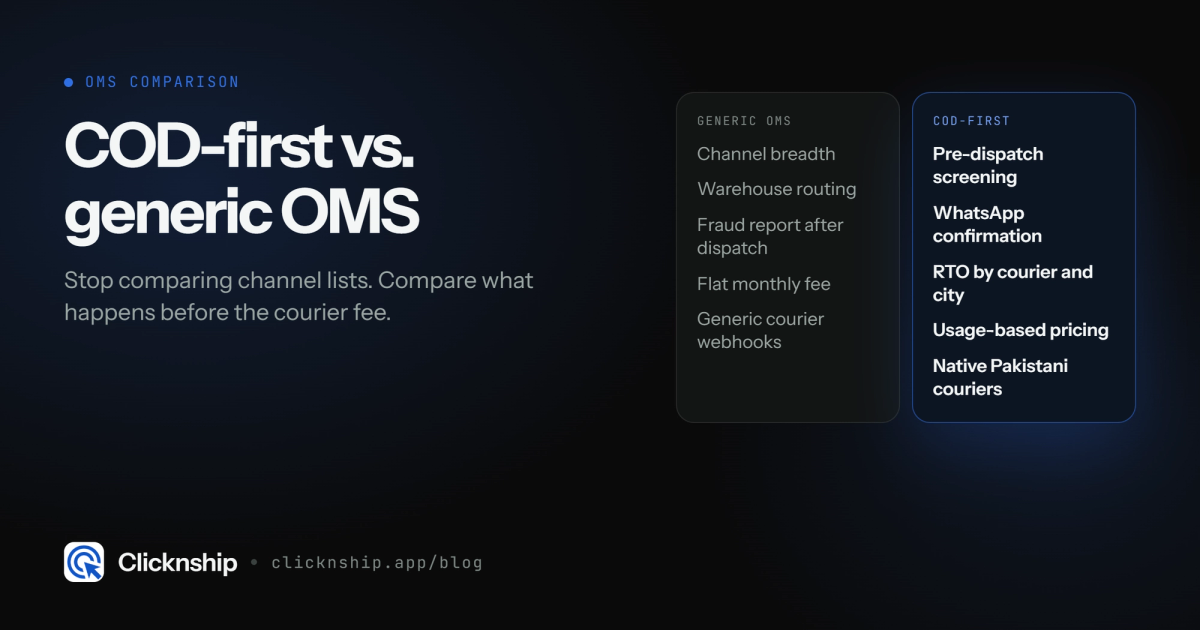
Multi-channel OMS platforms — the kind built for a Daraz + Shopify + WooCommerce seller in a prepaid-first market — optimize for channel breadth, inventory sync accuracy, and fulfillment routing across warehouses. Those are real problems, but they assume payment already happened, so the platform's job starts after the money risk is gone. In COD, the money risk starts the moment the order is placed and doesn't go away until the parcel is actually accepted.
What COD selling actually requires that generic platforms treat as an afterthought
Pre-dispatch screening for fake and duplicate orders, a confirmation step that reaches customers reliably, and RTO visibility broken down by courier and city rather than one blended return rate. Generic platforms often bolt fraud detection on as a post-dispatch report — useful for understanding what already happened, not for stopping it before a courier fee is spent.
Where multi-channel breadth genuinely matters
If your store genuinely sells across a dozen channels with large multi-warehouse fulfillment, breadth-first platforms solve a real problem and are worth the switch. If 80%+ of your volume is Shopify or Daraz COD orders, channel breadth you're not using is a feature you're paying for without benefiting from — while the thing that actually costs you money, screening and confirmation, gets treated as a secondary feature.
A practical comparison framework
Instead of comparing channel lists, ask what happens to a specific order type in each platform: a duplicate submission, a first-time customer in a high-RTO area, an order that goes unconfirmed for six hours. Ask for a live walkthrough of that specific flow, not a features page.
A short checklist
- Does the platform screen for fake/duplicate orders before dispatch, or only report fraud afterward?
- Is confirmation via a channel customers actually respond to, not just an internal dashboard status?
- Can you see RTO broken down by courier and city, not one blended percentage?
- Does pricing scale with your order volume, or lock you into a flat fee sized for a bigger multi-channel operation?
- Is Pakistani courier integration — TCS, Leopards, M&P, PostEx, Daewoo, Trax — native, or a generic webhook you have to configure yourself?
ClickNShip is built specifically for the COD-first case — the checklist above is effectively our product spec, not a marketing comparison.
FAQ
Is ClickNShip a replacement for Shopify or Daraz's own order tools?
No — it sits between your store/channels and your couriers, picking up at order entry (screening, confirmation) and handing off at dispatch. It complements Shopify or Daraz rather than replacing the storefront.
We sell on Shopify, Daraz, and WhatsApp catalog orders — is that still "COD-first"?
Yes. COD-first describes the payment and fulfillment risk profile, not the number of channels. A WhatsApp-catalog-plus-Shopify-plus-Daraz COD seller has the same screening and confirmation needs as a single-channel one.
How do we evaluate this without a long trial?
Ask for a walkthrough of specific order scenarios — a duplicate submission, a high-risk first-time customer, an order unconfirmed after six hours — rather than a generic feature demo. It surfaces the real difference faster than a feature list ever will.
Ready to compare ClickNShip against your current setup, on your own order data? Start with ClickNShip.