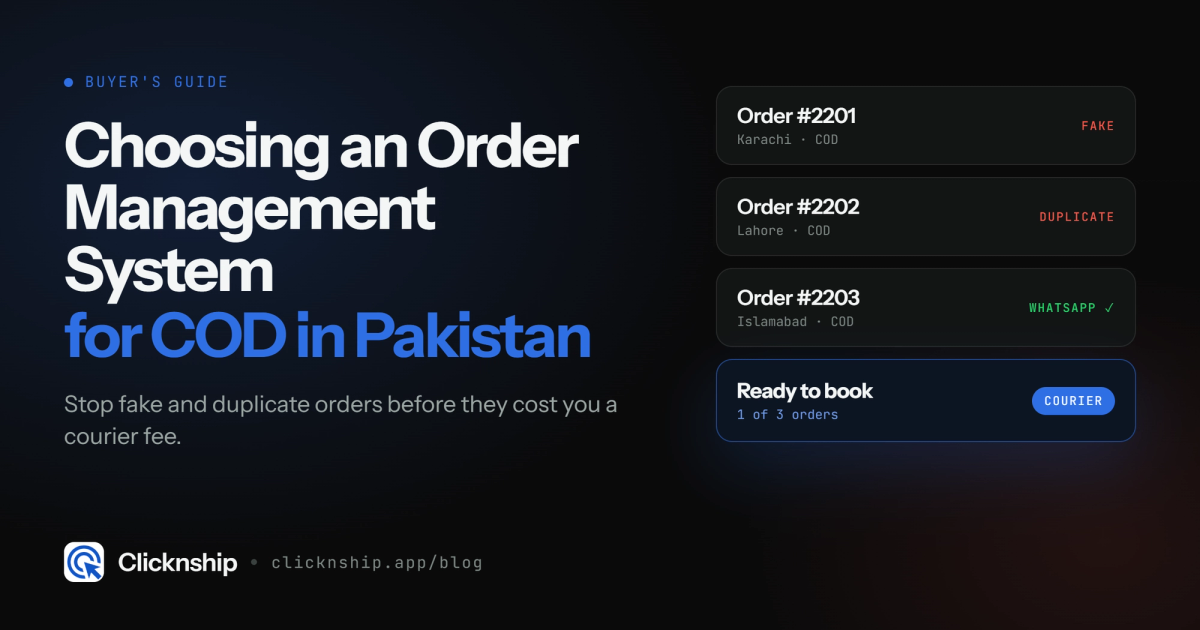
Order Management System in Pakistan: A 2026 Buyer's Guide for COD Sellers
Comparing order management systems for Pakistani e-commerce? Here's what actually matters for COD sellers — fake-order detection, courier booking, and WhatsApp confirmation — before you commit.

Umair
Founder @ ClicknShip.app | Helping eCommerce businesses reduce RTO, automate fulfillment, and improve operational efficiency
Most "order management system" write-ups for Pakistan read the same way: a list of channel integrations, a pricing table, and a demo button. What they skip is the thing that actually determines whether an OMS saves you money or just adds another dashboard — how it handles the two problems unique to cash-on-delivery selling here: orders that were never real, and orders nobody can confirm before a courier is already on the way.
Start with the problem COD sellers actually have
In a prepaid market, a bad order just means a refund. In COD, a bad order means you've already paid a courier pickup fee, tied up stock, and possibly dispatched a parcel that comes back three weeks later as an RTO. Fake orders — bots, prank submissions, competitors testing your checkout — and duplicate orders — the same customer submitting twice because your confirmation page was slow — cost real money before a single item ships.
Any OMS can log an order. Far fewer can flag, at the point of entry, which orders are statistically likely to be fake or duplicate before your team spends time confirming them. If you're evaluating platforms, ask for this feature by name — "pre-dispatch order screening" — not just "fraud detection," which usually means something that fires after the courier has already been booked.
Multi-channel sounds good; check what it actually means for confirmation
Platforms built for multi-channel retail (Shopify, Daraz, WooCommerce, a contact-center form) are genuinely useful if you sell across all of them. But channel breadth is a different problem from confirmation speed. The real bottleneck for most COD operations isn't "which platforms can feed in orders" — it's "how fast can a human or automated flow confirm an order before the customer changes their mind or disappears." WhatsApp-based auto-confirmation, where low-risk orders get confirmed automatically and only ambiguous ones go to an agent, closes that gap in a way plain channel integration doesn't.
Courier integration: one dashboard, or five browser tabs?
Nearly every OMS claims courier integration. The distinction that matters operationally is whether booking, tracking, and reconciliation across TCS, Leopards, M&P, PostEx, Daewoo, and Trax happen from one screen — or whether "integration" just means you still log into each courier portal separately for anything beyond basic booking. Ask specifically about load-sheet generation, bulk booking, and RTO/return tracking across couriers, since that's where most of the manual hours actually go.
A short checklist before you commit
- Does it screen orders before dispatch, or only report fraud after the fact?
- Can non-technical staff confirm orders without leaving WhatsApp?
- Is courier booking genuinely one dashboard, or several portals stitched together?
- Does pricing scale with your order volume, or does it lock you into a flat monthly fee regardless of a slow month?
- Can you see RTO risk and courier performance in the same report, or only after reconciling spreadsheets?
Where this leaves the decision
If your catalog spans a dozen sales channels and large-scale fulfillment operations, breadth-first platforms built for that scale are worth evaluating. If your core problem is COD-specific — stopping fake and duplicate orders before they cost you a courier fee, confirming faster over WhatsApp, and booking across Pakistani couriers from one place — that's a narrower, COD-first category. ClickNShip was built specifically for that second case, with usage-based pricing so a slow month doesn't carry a full platform fee.
FAQ
What's the difference between an order management system and a shipping/courier tool?
A courier tool mainly books and tracks shipments. An order management system sits earlier in the flow — it ingests orders from your store or channels, handles confirmation, and only then hands off to courier booking. For COD in particular, that earlier stage (screening and confirming) is where most of the preventable cost sits.
Do I need multi-channel support if I only sell on Shopify?
Not necessarily. Multi-channel breadth matters once you're actually selling across Daraz, WhatsApp catalogs, or a call center alongside Shopify. If you're Shopify-only, prioritize confirmation speed and fraud screening over channel count.
How much does an order management system cost in Pakistan?
Pricing models vary: some charge a flat monthly platform fee regardless of volume, others charge per order or per confirmed shipment. For sellers with seasonal or inconsistent volume, a usage-based model avoids paying full price during slow months.
Can an OMS actually detect fake orders before they're dispatched?
Yes, if it's built to screen at order entry — checking patterns like repeated submissions, mismatched contact details, or known abusive numbers — before the order reaches courier booking. Platforms that only report fraud in post-dispatch analytics don't prevent the cost; they just document it.
Want to see pre-dispatch screening and WhatsApp confirmation working on your own store's orders? Start with ClickNShip — pricing is usage-based, so a slow month never costs a full platform fee.