Returns & RTO Management for Pakistani COD Sellers: A Practical Guide
RTO quietly eats COD margins in Pakistan. Here's where it actually starts, the three checkpoints that catch it before dispatch, and how to measure it right.

Umair
Founder @ ClicknShip.app | Helping eCommerce businesses reduce RTO, automate fulfillment, and improve operational efficiency
Return to Origin — RTO — is the cost Pakistani COD sellers budget for last and feel first. A parcel that bounces back after transit has already consumed a pickup fee and a forward delivery fee that most couriers don't refund on a return, plus the warehouse handling and the inventory float for however many days it sat in transit. None of that shows up until you're reconciling COD remittance weeks later. Most "order management" pages treat returns as a tracking problem — mark it RTO, log it, move on. The actual lever is upstream: most RTO is decided before the parcel ever leaves the warehouse.
Why RTO is the hidden cost nobody prices in
In a prepaid store, a return just means a refund and a re-list. In COD, the seller has already paid for forward delivery whether or not the customer accepts the parcel — and that leg usually isn't refunded on a return. Add the stock tied up in transit and the staff time spent repackaging and reconciling, and a 15–20% RTO rate, common across unscreened COD stores, quietly removes a meaningful slice of margin before anyone looks at a P&L line called "returns."
Where RTO actually starts — it's rarely the courier's fault
It's tempting to measure RTO by courier and conclude one is "worse" than another. In practice, courier performance explains a minority of RTO. The bigger drivers sit upstream: an order placed on impulse with no real intent to pay, a phone number that was never going to answer a confirmation call, an address that's one village over from what the customer meant, or a customer who ordered the same thing twice and only wants one. By the time a courier attempts delivery, those orders were already going to fail — the courier is just where it becomes visible.
Three checkpoints that catch it before dispatch
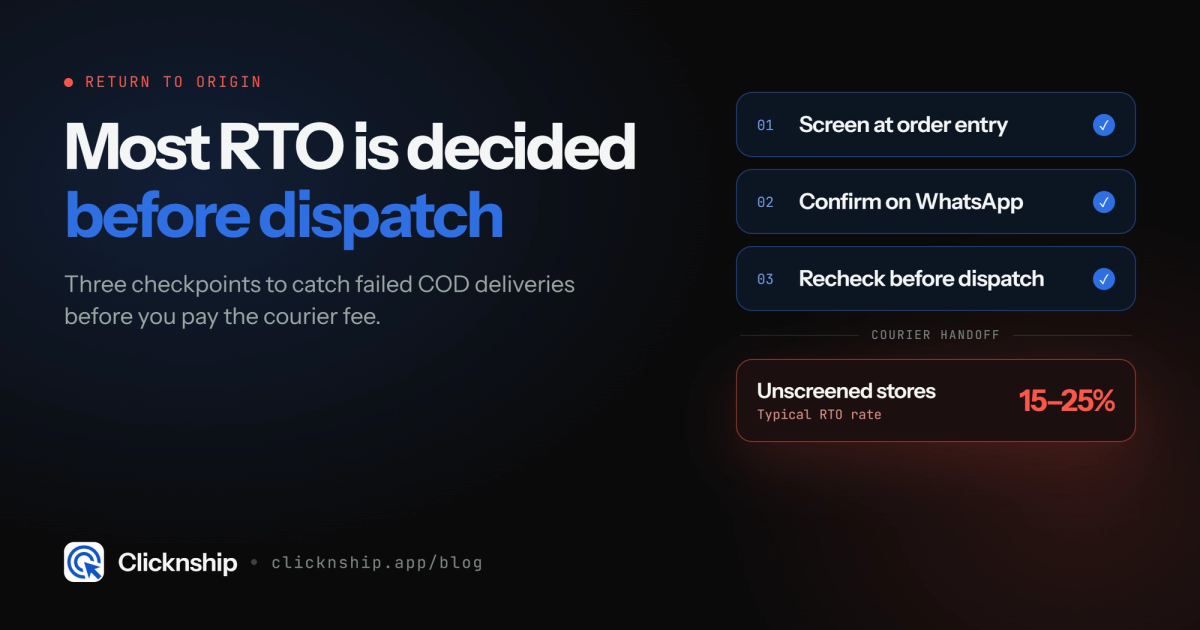
Screen at order entry. Flag orders with patterns that correlate with RTO — repeated submissions from the same device or number, known abusive numbers, mismatched name/address formatting — before they reach a courier label, not after a report runs.
Confirm before you commit a courier fee. A confirmation step that actually reaches the customer — not a call that rings out — is the single highest-leverage checkpoint. This is where channel matters: a message a customer reads and replies to beats a call they let go to voicemail.
Recheck address and stock right before dispatch. Orders confirmed days ago can go stale — the customer moved, or the item is already out of stock and a backorder is quietly ticking toward a failed delivery. A pre-dispatch recheck catches what changed between confirmation and courier handoff.
What to do once a parcel is already in transit
Even a well-screened order can still fail delivery — the customer is traveling, or simply misses the rider. An out-for-delivery WhatsApp heads-up gives the customer a chance to be reachable instead of finding out after the fact. And rather than letting a parcel default to RTO after a courier's standard two failed attempts, a proactive contact attempt before that status is set can recover deliveries that would otherwise just bounce back automatically.
Measure RTO the way that actually changes behavior
RTO rate is returned parcels divided by dispatched parcels — but the aggregate number hides where the problem actually lives. Break it down by city or area, by courier, by sales channel or ad source, and by the agent who confirmed the order. A single underperforming city, or a single ad campaign driving low-intent orders, often explains more of your RTO rate than courier choice ever will — but you can't see that in one blended percentage.
A short checklist before your next peak season
- Is every order screened for risk before it reaches a courier label?
- Does your confirmation step actually reach the customer on WhatsApp, not just a phone call they won't answer?
- Is address and stock re-checked at the point of dispatch, not just at order entry?
- Can you see RTO rate broken down by city, courier, and sales channel — not just as one aggregate number?
- Is there a proactive contact step before a parcel is marked RTO, or does that happen automatically after two failed attempts?
None of this requires replacing your courier. It requires catching the same orders earlier — at entry, at confirmation, and right before dispatch — and being able to see where in your operation RTO is actually concentrated. That's the combination ClickNShip is built around: pre-dispatch screening, WhatsApp confirmation that gets read, and RTO reporting broken down by courier and city rather than one blended number.
FAQ
What's a normal RTO rate for COD e-commerce in Pakistan?
It varies widely by category and screening quality — unscreened stores commonly see 15–25%+, while stores with consistent pre-dispatch screening and WhatsApp confirmation often bring it under 10%. There's no single "normal" number; what matters is whether yours is trending down as you fix the upstream causes.
Does changing couriers reduce RTO?
Sometimes, for specific cities where one courier's local network is weak — but switching couriers without fixing order screening usually just moves the same RTO rate to a different carrier.
Should I just stop accepting COD for high-RTO products?
That's a valid lever for individual SKUs or cities with persistently high RTO after screening, but it's a blunt instrument — most stores recover more margin by fixing confirmation and screening than by removing COD entirely in a COD-first market.
How does WhatsApp confirmation actually reduce RTO compared to a phone call?
Response rates are simply higher — customers read and reply to WhatsApp messages they'd let a call from an unknown number go to voicemail. It also leaves a timestamped, auditable confirmation instead of a call log entry.
Want to see your own RTO rate broken down by courier and city instead of one blended number? Start with ClickNShip.