WhatsApp Order Confirmation: How Auto-Confirmation Cuts RTO for Pakistani COD Stores
Confirming COD orders by phone call wastes agent hours and still misses customers. Here's how WhatsApp auto-confirmation actually works and why it lowers RTO.

Umair
Founder @ ClicknShip.app | Helping eCommerce businesses reduce RTO, automate fulfillment, and improve operational efficiency
Confirming a COD order the old way means an agent manually calling every order, often several times before reaching someone, then logging the result by hand. For a store doing a few hundred orders a day, that's multiple full-time agents doing nothing else. WhatsApp-based confirmation changes the channel — and, more usefully, changes which orders need a human at all.
Why phone confirmation doesn't scale
Most customers let a call from an unknown number ring out, so agents end up dialing two or three times per order before giving up or moving on. Agent capacity becomes the ceiling on how many orders you can confirm in a day, not demand. On peak days the backlog grows, and stores are left choosing between dispatching unconfirmed orders — which pushes RTO up — or holding orders until an agent gets to them — which delays every dispatch in the queue behind it.
What "auto-confirmation" actually means
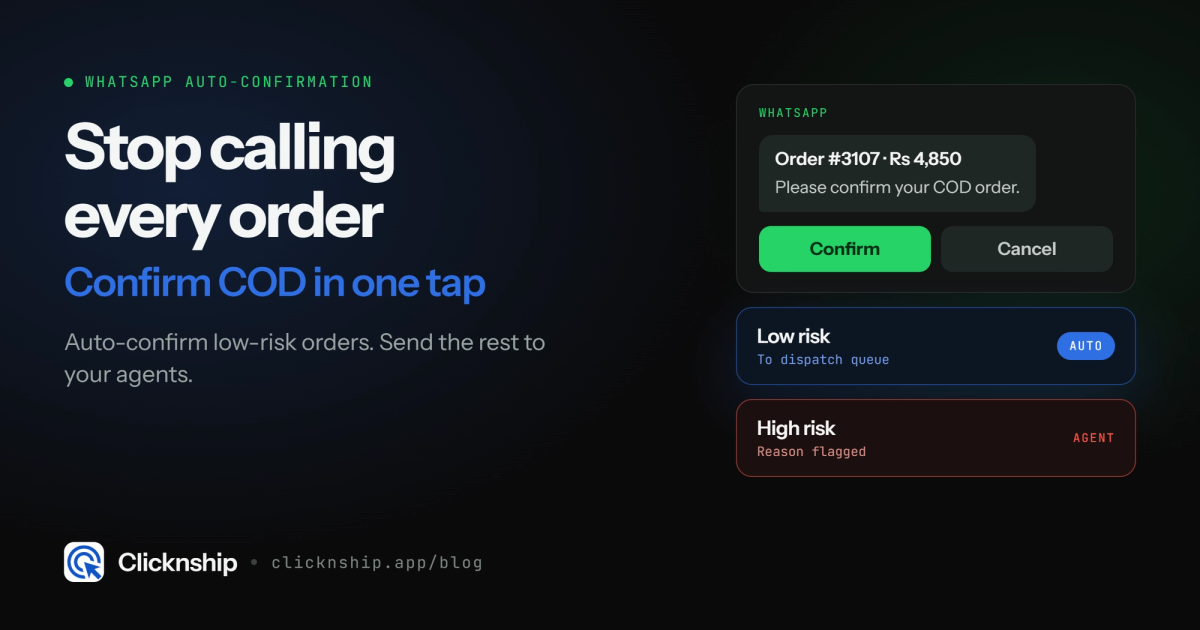
Not every order should be confirmed by a bot blindly. A well-built flow scores each order on arrival — repeat customer with a clean delivery history, address matching a known pattern, order value within a normal range — and auto-confirms the low-risk ones immediately through a WhatsApp message the customer can confirm with a single tap. Ambiguous or higher-risk orders route to an agent instead of flooding every order into the same queue.
Which orders should never be auto-confirmed
A first-time customer in a historically high-RTO area, an unusually large order value, multiple units of the same SKU, or an address that doesn't match a courier-serviceable format — these should go to a human. Auto-confirmation isn't "trust everything"; it's removing agent time from the 70–80% of orders that don't actually need a judgment call, so agents can focus on the ones that do.
What a good WhatsApp confirmation flow looks like end to end
An order comes in and gets a risk score within seconds. Low-risk orders get a WhatsApp message with the order summary and a confirm/cancel option within minutes — a tap moves the order straight into the dispatch queue. Higher-risk orders route to an agent queue with the specific risk reason flagged, so the agent knows what to check rather than starting cold. If there's no response in a set window, an automatic follow-up goes out before the order is flagged for agent review — it's never silently dispatched blind or silently dropped.
What to measure once it's live
Track confirmation response rate within a set time window, the split between auto- and agent-confirmed orders, and time-to-confirm. The number that actually proves the switch is working is RTO outcome broken down by confirmation method — if auto-confirmed orders return at a similar or lower rate than agent-confirmed ones, the scoring is doing its job; if not, the risk rules need tightening before volume scales further.
A short checklist before you switch
- Does the confirmation message look like it's from your brand, not a generic bot ping customers learn to ignore?
- Can customers confirm or cancel with one tap, rather than a typed reply your system has to parse?
- Are high-risk orders routed to a human instead of auto-confirmed by default?
- Is there a follow-up step before an unconfirmed order is dropped or dispatched blind?
- Can you see confirmation method — auto vs. agent — against RTO outcome, to prove it's actually working?
This is the confirmation layer ClickNShip's WhatsApp auto-confirmation is built around: risk-scored orders, one-tap confirmation for the low-risk majority, and agent queues for everything that actually needs a person — with RTO outcome tracked against confirmation method so you can see whether it's working, not just assume it is.
FAQ
Does WhatsApp auto-confirmation replace my confirmation team entirely?
No — it removes the repetitive bulk of low-risk orders from their queue so agents spend their time on the orders that actually need a judgment call, instead of calling every single order regardless of risk.
What if a customer doesn't have WhatsApp?
Fall back to SMS or a call for that segment. WhatsApp covers the majority of Pakistan's COD customer base, but a confirmation system still needs a fallback channel rather than assuming one channel reaches everyone.
Can customers cancel an order through WhatsApp?
Yes, and it's one of the more valuable outcomes — a customer canceling before dispatch costs nothing, compared to the same order becoming an RTO after a courier fee is already paid.
How fast should the first confirmation message go out after an order is placed?
Within minutes, while the purchase is still fresh in the customer's mind — confirmation requests sent hours later measurably get lower response rates.
Want your low-risk orders confirming themselves while agents focus only on the ones that need a human? Start with ClickNShip.